
Work has completely changed in these 5 ways

To get a clearer understanding of the changing employment landscape, CareerBuilder partnered with The Harris Poll to survey thousands of hiring managers and workers. Here’s what’s on their minds.
Skills are crucial.
The skills gap is now unavoidable for most employers.
- The majority of hiring managers (69%) are concerned about the growing skills gap in the U.S.
- More than 2 in 5 workers feel they do not have the skills to advance in their career, and this sentiment has nearly doubled since 2019.
Still, the overwhelming majority of both groups are eager for more training.
- 89% of hiring managers strongly believe an increased emphasis on training and development would be beneficial to all employees.
- 91% of workers are ready for the help and say it’s important for them to continually learn new skills that could advance their career.
Better pay is essential.
Salary and benefits are workers’ main criteria in applying for jobs, with nearly 40% of workers saying they rely on side jobs to make ends meet. The top dealbreaker when interviewing for a job is learning the starting salary is lower than what was posted on the job description, and among those who have ghosted a new employer, two-thirds say it is because they found a job with higher wages or better benefits.
Employers seem to be feeling the pressure.
- 62% of hiring managers plan to increase initial job offers for new employees.
- Among hiring managers who have minimum-wage workers, 56% plan to pay them $15 or more per hour, with the largest companies (5,001+ employees) the most likely to report this (68%).
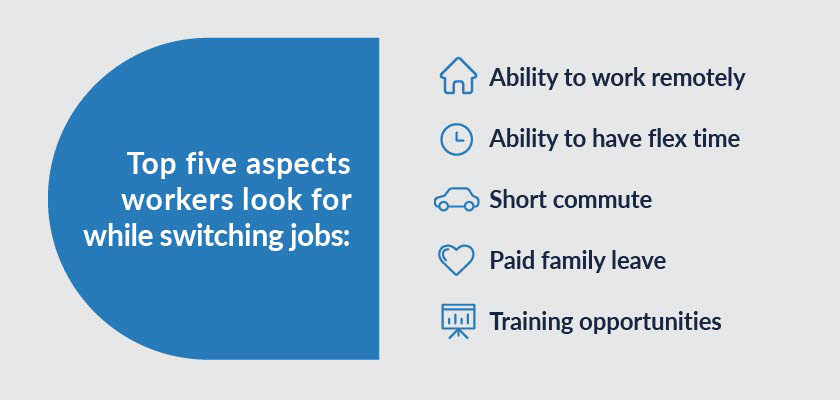
More than a third of current workers expect at least a 5% salary increase each year; nearly twice as many expect this when switching jobs. The top five things workers look for when they do switch jobs:
- Ability to work remotely.
- Flex time.
- A short commute.
- Paid leave, especially for parents and caretakers.
- In-house training.
Work ≠ life.
It’s no secret the pandemic has shaped workforce expectations, and both workers (78%) and hiring managers (75%) report their company has made long-term changes in response to employee requests.
- 80% of hiring managers believe there will be higher employee turnover if employers do not accommodate employees’ personal lives.
- Nearly 2 in 5 hiring managers feel their company’s remote employees struggle to disconnect after work hours, and even more remote workers say they struggle with this.
Diversity and equity need inclusion.
A year of protests and the pandemic revealed disparities across every aspect of society, including the workplace. The majority of hiring managers (69%) say diversity, equity and inclusion (DE&I) is at least a moderate priority at their company. Even more workers (80%) feel the same. Many companies are already addressing DE&I areas, but there’s room for improvement – around 3 in 10 workers would like their company to address this more over the next few years.
Tech isn't human enough.
Although automation frees up employers to personally interact with candidates throughout the hiring process, too much tech is a concern for job seekers. 71% of workers agree that automation in the job search and hiring process makes it impossible to know if the company's culture is the right fit. Prioritizing job seekers in automated processes should be a top concern for employers. If used right, technology should allow you to save time and focus on the human aspects of hiring.
Takeaways as you attract and retain talent: offer upskilling and training opportunities, pay competitive wages, promote a flexible work schedule, and prioritize humanity in hiring efforts.
For more insights, read the full report.


Recommended Content:
-

Female workers nearly 3x more likely to think there is pay disparity at work
Explore the causes behind the scenes of female pay disparities in the workplace before exploring how organizations can take a proactive approach to equal pay.
Read Article
-

Do’s and don’ts for making the workplace fun
Forcing fun in the workplace can backfire, so use the do’s and don’ts in this guide to help you make the right move when you’re trying to encourage fun at work.
Read Article
-

Supply chain trends that can impact hiring
Discover top supply chain trends that can impact hiring, including some roles emerging in relation to these trends, to help your company remain competitive.
Read Article